
For marketers who use AI, Google’s attitude is clear: It doesn’t matter who (or what) wrote the words. Quality trumps everything.
In September 2025, Google released a broad update to its rates guidelines for search quality, originally reported by the search engine’s soil. The changes included an extended definition of generative AI, new examples such as AI listings and stricter expectations of your money or your life (Ymyl) content.
The update reinforces a rule that was introduced earlier this year: scaled low value content must receive the “lowest” assessment, whether created by humans or AI.
The search quality guidelines define generative AI as a machine learning model that creates new content (text, images, music or code) based on training data. Google notes that AI can help with content creation, but warns that it is often linked to scaled abuse and low paraphrasing.
As detailed in the guidelines:
“[Pages] With little or no effort, little or no originality and little or no added value for the site visitors ”should be assessed lowest. Likewise, the use of generative AI tools alone does not determine the level of effort or side quality assessment.
Takeaway is clear: Quality means more than authorship. This message reflects growing consensus among SEOs:
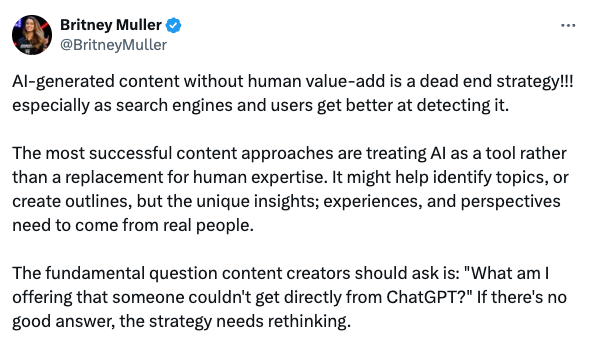
“AI-generated content without human value added is a dead end strategy,” AI and SEO consultant Britney Muller posted to X earlier this year. “[E]Especially when search engines and users get better at discovering it. “
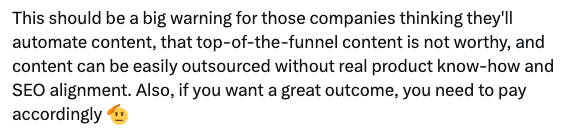
Aleyda Solís, international SEO consultant and founder of Orainti, shared a similar warning in response to an open job shooting: “This should be a major warning for companies that think they will automate content … Content can easily outsourced without real product know-how and SEO customization.”
How does Rater’s quality judge?
The guidelines add details of how raters should evaluate high quality main content (MC). High quality MC has long been expected to show effort, originality and skill, and the update strengthens these standards with extended examples.
For information or your money or your life (Ymyl) topics are the effort higher. Misleading or low content of health, finance or citizen topics is considered especially harmful.
Reputation also matters. Raters check if the site and its creators are identifiable and credible. Lack of author information, unclear sources or weak reputation signals lead to lower ratings.
Even structure plays a role: If MC is hidden behind tabs or buried under ads, quality perceptions fall.
Ross Hudgens, founder and CEO of Siege Media, explained to LinkedIn that most AI work overlooks the unique value added that makes content-rankable:
“Most AI content is powered by the 80/20 rule .. without 20.
It is true that for most content, 20% of the content drives 80% of the value. It is the data or designed or hook or the short answers that are the central part of the asset.
When people create content at end to end with AI, they never identify their 20%. ”

Why does the update mean something to SEO?
For SEOs, the September update for Google’s guidelines for rater quality rates Rates Rater-Guidelines A long-lasting rule: Pages of scaled content with low value can be assessed “Lowest.” What is new is that the guidelines now explicitly include generatively AI-produced content as a potential source of such a low value content.
The guidelines do not change Google’s algorithms. They train human rates to assess search results. These ratings do not directly affect rankings, but help Google evaluate whether its algorithms are reliable sides of high quality.
By attaching AI-output to scaled, low-value practices, the update signals that both algorithms and users are already becoming better at detecting low or repeated text.
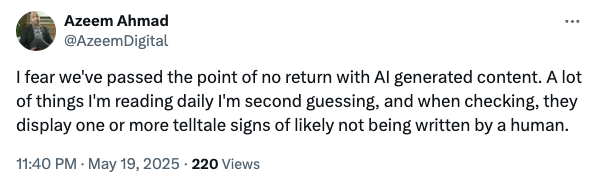
“A lot of things I read daily, I am second guessing, and when they control they show one or more narrative signs that they are probably not written by a human being,” Azeem Digital, an international digital marketing and consultant, shared at X.
The implication is straightforward, albeit not necessarily new: Google is rewarding content that demonstrates originality, accuracy and trust. And punishing shortcuts.
Stay ahead with semrush
Marketing people need to customize workflows with Google’s updated standards and rising user expectations. Too many brands, it means using AI for efficiency while relying on human expertise in trust and value.
Semrush Content Toolkit is built for this balanced workflow:
- Generate with SEO short generator. Build a data -driven brief that shows what top priesting pages in your space is doing. Use it to structure content and identify semantically related keywords.
- Draft of AI article generator. Use the brief as a guide so AI-assisted drafts cover the right topics and deliver real value.
- Optimer with Content optimization. Check for originality, tone and readability. Remove generic formulation and show human authority.
- Validated with trust signals. Add author information, fact -control thoroughly, and include unique insight to demonstrate expertise and originality.